Friday, April 24, 2015

Nursing Govt Jobs 2015 (26 Vacancies Opening)


Nursing Govt Jobs 2015 (26 Vacancies Opening)

Nursing is one of the best profession in the health care sector. Nursing (Staff Nurse) in India is the practice of care for medical patients. Every year, Lot of Nursing vacancies opening in Indian Government (Public) Hospital such as AIIMS, JIPMER, ESIC Hospital and Indian Army Hospital and Nursing Corps.
In India, All Nursing courses (Degree / Diploma) from any Institution / University recognized by the Indian Nursing council or State Nursing Council. The Indian Nursing Council is an Autonomous Body under the Government of India, Ministry of Health & Family Welfare was constituted by the Central Government.
Minimum Educational Qualification: 3 years Diploma in General Nursing and Midwifery (OR) 4 years B.Sc Nursing or equivalent recognized by the Indian Nursing council or State Nursing Council. 
 Blog will update latest Govt Nursing Job Vacancies List Here: (Last Updated on 23rd April 2015):
Job Location
Name of the Post - Total Vacancies
Last Date for Apply
Detailed Info
Central Institute of Psychiatry (CIP)
Staff Nurse - 20
30/04/2015
CCRS
Staff Nurse - 06
05/05/2015

Sunday, April 19, 2015

Seventh Central Pay Commission


In a resolution dated 28th February, 2014, Government of India has appointed the Seventh Central Pay Commission comprising Justice Shri Ashok Kumar Mathur as Chairman, Shri Vivek Rae as full time Member, Dr. Ratin Roy as part time Member and Smt. Meena Agarwal as Secretary. The Commission is headquartered in Delhi and has been given 18 months from date of its constitution to make its recommendations. To this end the Commission will set up its team of Officers, Advisers, Institutional Consultants and Experts and call for required information and documents from Ministries and Departments of Government of India and various Service associations.
The dates of appointment and submission of recommendations of the previous six central pay commissions are as under-
Central Pay Commissions Date of Appointment Date of Submission of Report
First Pay Commission May, 1946 May, 1947
Second Pay Commission August, 1957 August, 1959
Third Pay Commission April, 1970 March, 1973
Fourth Pay Commission June, 1983 Three Reports submitted in June, 1986;
December, 1986 and May, 1987 respectively
Fifth Pay Commission April, 1994 January, 1997
Sixth Pay Commission October, 2006 March, 2008

Class - I Admission Selected List n ... KVS Selected List-2 (click here)

Latest list of KV Schools in Tamil Nadu


The latest and total (37) list of KV Schools in Tamil NaDU Chennai
1. Chennai (CLRI)
2. Chennai (Anna Nagar)
3. Chennai (K.K.Nagar)
4. Chennai (DGI Complex)
5. Chennai (Gill Nagar)
6. Chennai (IIT)
7. Chennai (Island Grounds)
8. Chennai (Menambakkam)
9. Chennai (Tambaram -1)
10. Chennai (Tambaram -2)
11. Chennai (Avadi AFS)
12. Chennai (Avadi CRPF)
13. Chennai (Avadi HVF)
14. Chennai (Avadi OCF)
15. Chennai (Arakkonam – 1)
16. Chennai (Arakkonam – 2)
Madurai
1.KENDRIYA VIDYALAYA No.1(MADURAI – Narimedu)
2.KENDRIYA VIDYALAYA No.2(MADURAI – Thirupparrankundram)
Coimbatore
1. KENDRIYA VIDYALAYA (Sowripalayam Road- Coimbatore)
Trichy
1. KENDRIYA VIDYALAYA (Ordnance Estate - Trichy)
2. KENDRIYA VIDYALAYA (HAPP - Trich)
Kalpakkam
1. KENDRIYA VIDYALAYA (DAE Township - Kalpakkam)
2. KENDRIYA VIDYALAYA (Sadras - Kalpakkam)
Dharmapuri
1. KENDRIYA VIDYALAYA (Lakkiampatti - Dharmapuri)
Aruvankadu
1. KENDRIYA VIDYALAYA (Cordite Factory - Aruvankadu)
Dindigul
1. KENDRIYA VIDYALAYA (Gandhigram - Dindigal)
Karaikudi
1. KENDRIYA VIDYALAYA (CECRI Campus - Karaikudi)
Wellington
1. KENDRIYA VIDYALAYA (Wellington - Nilgris)
Vijayanarayanam
1. KENDRIYA VIDYALAYA (Vijayanarayanam - Tirunelveli)
Thiruvannamalai
1. KENDRIYA VIDYALAYA (Gandhi Nagar - Thiruvannamali)
Thanjavur
1. KENDRIYA VIDYALAYA (Air force Station - Thanjavur)
Sulur
1. KENDRIYA VIDYALAYA (Air Force Station - Sulur)
Sivagangai
1. KENDRIYA VIDYALAYA (Srinivasa Nagar - Sivaganga)
Rameshwaram
1. KENDRIYA VIDYALAYA (Varthagan Street Road - Rameshwaram)
Ooty
1. KENDRIYA VIDYALAYA (Indu Nagar - Ooty)
Nagerkoil
1. KENDRIYA VIDYALAYA (Konam - Nagerkoil)
Mandapam
1. KENDRIYA VIDYALAYA (Mandapam Camp - Mandapam)

ocf kv selection list

DIRECT RECRUITMENT NURSE

    The Medical Services Recruitment Board (MRB) has been established with the objective of making direct recruitment to various categories of staff in the Health and Family Welfare Department, Government of Tamil Nadu.                                                                                                                                                                                                                                                                                             http://www.mrbexam.in/nurses/register.php
    http://www.mrbexam.in/

Saturday, April 18, 2015

Forms (Tamil Nadu)

7th Pay Commission Minimum Wage


In the Memorandum submitted to 7th pay commission, the NCJCM demanded the pay commission that the   minimum Pay should be fixed at Rs.26000/-. Detailed information with statistical data has been provided in the report for justifying the demand to fix Minimum wage at Rs.26000/-. It appears that NCJCM is firm on its claim for minimum wage.  In the Meeting held recently with NCJCM , the 7th pay commission confronted with the price quoted for essential commodities by NCJCM. Hence the NCJCM asked its affiliates to obtain price list from all the Metros to establish their claim on price is correct, so that the minimum wage can be arrived as per Dr. Dr. Aykhrod formula to Rs.26000/-. The Chapter V of the NCJCM’s Memorandum submitted to 7th pay commission describes the need and reasons for minimum wage to be assigned at Rs.26000.
Chapter V
Minimum Wage
     All the Pay Commissions were of the firm opinion that wages cannot be determined on any single principle but has to be based upon a combination of all the enunciated principles or those principles are to be factored into the process of quantification. Since the Government as an employer had not been able to grant the need based minimum wage to its own employees till date we are of the firm opinion that the 7th CPC must endeavour to compute the wage structure on 15th ILC norms. We suggested two other principles to be factored into the quantification of pay beyond the minimum level.  We enumerate hereunder the factors to be taken into account:
(1) The Need-Based Minimum Wage concept to compute pay at the minimum level.
(2) The intrinsic value of the job content of each grade and post at the intermediary level to be assessed by an expert committee. Pending finalization of such a study, the Commission may maintain the presently existing vertical and horizontal relativities.
(3) To take into account the outside rates to determine the pay package at senior levels of bureaucracy but maintain the ratio between the minimum and maximum at 1 : 8 (MTS to Secretary to Govt. of India).
5.2. We make the above suggestions as just and reasonable on the following grounds:
(1) The Fair Wage Committee has held that an industry which is incapable of paying minimum wage has no right to exist.
(2) 88% of Central Government Employees are industrial or operational workers.
(3) The need based minimum wage concept formulated by Dr. Aykroyd and approved by 15th ILC was considered the most important principle in computing salary of Government employment especially of lower level functionaries, by the 2nd, 3rd, 4th and 6th CPC.
(4) It is only the fear of a heavy financial implication and the incapacity of the Indian economy at the relevant point of time, to meet the extra expenses that the 2nd, 3rd and 4th CPCs were constrained to alter the formula itself, detrimental to the interest of employees, basing their conclusion on the opinion of certain nutritional experts. The legitimacy provided to Dr. Aykroyd formula by the 15th ILC (in which the representative of Labour, Employers and Government participated) was not available for any other conceptual frame work proposed by any other “experts”. The 4th Pay Commission cited the per capita net national product increase over the years to justify lower minimum wage than what could have been as per the ILC norms. It could be seen that the earlier Pay Commissions had adopted a different principle other than the Dr. Aykroyd formula due to financial constraints.
(5) Despite elaborately detailing the concept of living wage and the purport and relevance of the amendment to the preamble of the Indian Constitution, the 4th CPC did not compute the pay structure on the basis of need based minimum wage formula. They stated that since the increase in the per capita net national product is an indication of the health of economy, they may be unable to fix the minimum wage at an amount higher than Rs.750/-.
(6) There had been no indication in the terms of reference by which the 5th CPC could have examined the need based minimum wage concept evolved by the 15th ILC. Still they dwelt upon the said concept in detail in their report. In fact they advocated that the 25% addition suggested by the Supreme Court to enable the worker to meet the expenses, viz., children education, medical requirements, social obligation connected with festivals, marriages, etc. must be added to arrive at the minimum wage. However, while computing the minimum wage, they discarded the theory of Need based Minimum wage. They adopted the percentage increase over ten years of the per capita net national product as the sole criterion to determine the minimum pay. (In other words they advocated the constant relative income criterion as the most equitable norm for fixing the minimum wage of the Central Govt. employees.). In order to arrive at the minimum pay, the Commission thus added 30.9% over the emoluments of a lowest paid employee as on 1.1.1996
(7) The 6th CPC adopted the 15th ILC norms to compute the minimum wage but made several changes to the concept Viz., the retail prices of the commodities which goes into the reckoning was altered; the stipulated 10% for housing and 25% for social obligations, medical, children education, etc. were discarded on the specious plea that separate allowances had been granted. 15th ILC had factored 7.5% as housing component in the computation of minimum wage. The question of incorporating the cost of requirement for medical, education and other social obligation was the subject matter of litigation before the Supreme Court. The Hon’ble Court directed that 25% of the minimum wage so computed must be added as a factor for the above requirement of a worker, which had not been taken into account in the ILC norms.
5.3 The contention of the 6th CPC that since children education allowance, Medical and house rent allowances are specially granted to the Central Govt. employees, the same must be taken out of the reckoning is not only wrong but also amounts to contradiction of a stand taken by the Highest judiciary of the country- Supreme Court. The 6th CPC has failed to take note of the fact that the allowances, be it HRA, Children Education allowance or Medial, granted are awfully insufficient to meet the requisite expenses. Had it not been the case, the 3rd CPC also ought to have taken the similar stand adopted by the 6th CPC. The computation appearing in page No. 60, Chapter 6 (3rd CPC report) establishes our view in the matter. We have given in Table (5.1) the computation of minimum wage as per 15th ILC norms. The retail prices of the commodities/articles are the average of the retail prices ruling as on 1.1.2006 at the following cities:
1, New Delhi. 2. Mumbai, 3 Chennai, 4., Kolkata , 5. Hyderabad, 6. Bhubaneswar, 7. Trivandrum and 8. Bangalore.
5.4 The minimum wage as per our computation works out to Rs.20,861/-. This must be the minimum wage for the unskilled worker as per the ILC norms. In Central Government employment presently there are no unskilled labour. The lowest level of employment is multiskilled worker/employee. The minimum educational qualification prescribed is either ITI or matriculation (10th Standard). The percentage increase of the wages of a skilled worker to that of an unskilled worker on an average had been more than 25% all throughout (2440-3050=610 i.e. 25% of Rs. 2440) We have therefore added 25% to arrive at the minimum pay for the lowest employee in Government service, which comes to Rs. 26,075/- , i.e. Rs. 26,000/- when rounded off. While computing the minimum wage, we have gone strictly as per the norms prescribed by the 15th ILC. However, we must state that the three units norm for the family prescribed by Dr. Aykroyd in the present situation is far below the requirement. The family consists of not only husband, wife and two children but invariably includes the parents of the head of the family. In Indian conditions, they totally depend upon the earning employee. If we factor two more units for the family concept, the minimum wage so worked out will increase by two third. In quantum terms, the pay at the lowest level of the Central Government will then be Rs. 43,330.
Table 5.1
PRICES OF THE INGREDINTS SPECIFIED IN TEH 15TH ILC TO CALCULATE THE MINIMUM WAGES AS ON 01.05.2014
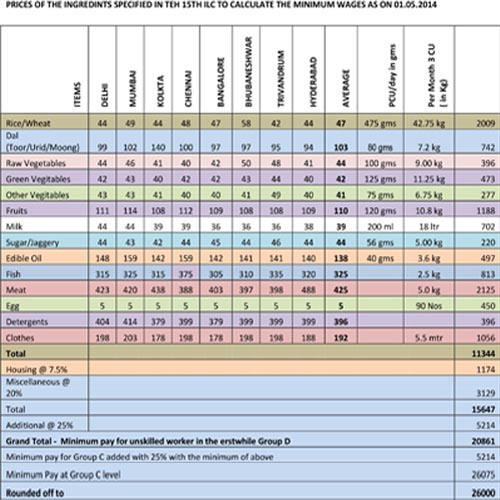
7th pay commission minimum wage Rs.26000
20% of the net minimum miscellaneous charges towards fuel, electricity, water charges, etc
Housing at the rate of 7.5% of net minimum
Addition Expenditure at the rate of 25% includes expenditure towards education, marriage etc of the children, Medical treatment, recreation, festivals etc. as per the Supreme Court decision in 1991.
5.5. Incidentally, we may mention that the minimum wages at the level of an unskilled worker as per recent wage agreement in Coal India Ltd. is Rs.29697/-. as per details given hereunder
(Table 5.2.)
Basic Pay
Rs. 15, 712
Dearness allowance 29.6%
Special allowance 4.0%
Special DA. 1.795%
Attendance bonus 10%
Total: 49.395% Rs. 7132.46
Total salary:
Rs.22844.46
At the MTS level 22.844.46 x 125% Rs.28555.58

5.6 The per-capita Net National Product increase at factor cost between – (2004-05 – 2011-12) years as per the Economic Survey for 2012-13 presented to Parliament is 57.55..%. The exact figures for the years 2012-13 and 2013-14 is not available from official websites. These figures are needed to arrive at a percentage of increase for the last 10 years. On the basis of the present data, the increase registered in quantum terms will work out to Rs. 22857, which is more than the minimum wage computed as per the 15th ILC norms.
(Table 5. 3)
A. Per Capita NNP at constant price for 2004-05 Rs. 24,143
B. Per capita NNP at constant price for 2011-12 Rs. 38,037
C. The increase registered over 8 years. Rs. 13,894
D.  Percentage increase over 2004-05 57.54877
E. Emoluments as on 1.1.2014 Rs. 14,000
F. 57.55% of Rs. 14,000. Rs. 8,057
G Wage to be fixed as on1.1.14 Rs. 22057

5.7. For the reasons stated in the preceding paragraphs and more specifically for the reason that the Government has presently the capacity to pay as detailed in Chapter III of this memorandum, we request the 7th CPC to recommend the minimum pay to be assigned to the lowest level of Group C functionary in Government of India service at Rs. 26,000/-

EXPECTED DA JULY 2015


Consumer Price Index for Industrial Workers (CPI-IW) – January, 2015

The All-India CPI-IW for January, 2015 increased by 1 point and pegged at 254 (two hundred and fifty four). On 1-month percentage change, it increased by 0.40 per cent between December, 2014 and January, 2015 when compared with the decrease of (-) 0.84 per cent between the same two months a year ago.

The largest upward pressure to the change in current index came from Housing group contributing (+) 1.36 percentage points to the total change. At item level, Wheat, Wheat Atta, Arhar Dal, Masur Dal, Moong Dal, Groundnut Oil, Mustard Oil, Fish Fresh, Goat Meat, Milk, Cigarette, Firewood etc. are responsible for the increase in index. However, this increase was restricted by Rice, Eggs (Hen), Onion, Vegetable and Fruit items, Sugar, Petrol etc., putting downward pressure on the index.

The year-on-year inflation measured by monthly CPI-IW stood at 7.17 per cent for January, 2015 as compared to 5.86 per cent for the previous month and 7.24 per cent during the corresponding month of the previous year. Similarly, the Food inflation stood at 7.81 per cent against 5.73 per cent of the previous month and 8.94 per cent during the corresponding month of the previous year.
At centre level, Haldia reported a maximum increase of 18 points followed by Jamshedpur (7 points), Lucknow (6 points), Quilon (5 points) and Srinagar & Vadodra (4 points each). Among others, 3 points rise was observed in 6 centres, 2 points in 9 centres and 1 point in 17 centres. On the contrary, Rourkela recorded maximum decrease of 7 points followed by Bhilai & Coimbatore (5 points each), Madurai & Labac Si!char (4 points each). Among others, 3 points fall was registered in 5 centres, 2 points in 2 centres and 1 point in 13 centres. Rest of the 15 centres’ indices remained stationary.

The indices of 36 centres are above All India Index and other 40 centres’ indices are below national average. The index of Bhopal and Bokaro centre remained at par with all-India index.

The next index of CPI-IW for the month of February, 2015 will be released on Tuesday, 31st March, 2015. The same will also be available on the office website www. labourbureau. gov. in.

 
(S.S.NEGI)
DIRECTOR

Forms (Tamil Nadu)

    •  

    Forms (Tamil Nadu)

  1.  
    Application form for obtaining the income certificate
  2.  
    The application form for obtaining a transfer of registry - Simple Transfer or Sub division
  3.  
    To view the Secretariat Office Manual
  4.  
    The application form form the Registration of Hindu Marriage under hindu marriage act
  5. The application form for the Annual Maintenance Grant from Amalgamated Fund to disabled in action
  6.  
    The application form for availing the Grant From Raksha Mantri Discretionary Fund
  7.  
    The application form for Government Incentive To Parents who send their only Son / Sons / Daughter For Service In Armed Forces
  8. Suggested application for Cash Grant From Government of Tamil Nadu By the Recipients of Gallantry Award or Distinguished Service Medal
  9. The application for obtaining the Grant of Financial Assistance from Disabled Army Personnel Widows Orphans Fund
  10.  
    The application for Marriage or Housing Grant from the Amalgamated Fund
  1. Labour & Employment (Tamil Nadu)

  2.  
     
    cut off seniority dates, community-wise break up details in Employment Offices of Tamil Nadu
  3.  
     
    Results, Recruitment and Notifications of Teachers Recruitment Board, Tamil Nadu.
  4.  
     
    Online registration for employment
  5.  
     
    Online Tentative Answer Keys of various examinations conducted by Tamil Nadu Public Service Commission
  6.  
     
    Notifications of Examinations, Results, Recruitment and other services rendered by Tamil Nadu Public Service Commission
NEW DELHI: The government is set to liberalise foreign direct investment norms for non-resident Indians as part of its efforts to boost capital flows in sectors such as defence and railways.

The department of industrial policy and promotion (DIPP) has sought Cabinet approval to allow NRI non-repatriable funds to be considered on a par with domestic investment instead of F .. 


  1. Related Links

  2.  
    Users can find detailed information about the Ministry of Petroleum and Natural Gas and its various functions which include exploration and production of oil and natural gas, refining, distribution, marketing, import, export, conservation of petroleum products and Liquified Natural Gas (LPG) in the country. Information is provided on the ministry's flagships programmes, petroleum conservation, investment and opportunities etc. Related policies, acts, rules and notifications are given.
  3. Ministry of Petroleum and Natural Gas
  4.  
    Detailed information related to the use of natural gas is provided by the Ministry of Petroleum and Natural Gas. Users can find details of availability and utilization of natural gas, supply of natural gas and natural gas allocation etc. Information is provided on gas pricing and LNG projects.
  5. Ministry of Petroleum and Natural Gas
  6.  
     
    Users can find detailed information on the conservation of petroleum products provided by the Ministry of Petroleum and Natural Gas. Information is provided on conservation, utilisation, refining sector, petroleum conservation research and multimedia mass awareness programme. Details of adoption of conservation of petroleum in various sectors are also provided.
  7. Ministry of Petroleum and Natural Gas
  8.  
     
    Distribution details of LPG cylinders to consumers of the Indane, Bharatgas, HP Gas Limited can be checked. User can see details of LPG usage, LPG booking status, LPG refill history, subsidy availed etc. The information on the portal can be sorted by consumer number, consumer name and by distributors' name. Users can also file complaint, request for surrender of their connection and apply for a new connection online.
  9. Ministry of Petroleum and Natural Gas
  10.  
     
    Direct Benefit Transfer for LPG consumer (DBTL) by Ministry of Petroleum and Natural Gas is the scheme aimed to improve the subsidy administration of LPG across the country. Information about DBTL, its methodology, eligibility criteria for receiving subsidy in bank account and DBTL districts is given. Users can access list of aadhaar enabled banks, DBTL helpline, DBTL forms, etc. Details related to checking aadhaar enrollment status, aadhaar enrollment centres, generating e-aadhaar, linking aadhaar to LPG consumer number, etc. are also available.
  11. Ministry of Petroleum and Natural Gas
  12.  
  13.  
    Bank Account – Aadhaar Linkage Application Form (For LPG Consumers only) is available. This service is provided under the Scheme of Direct Benefit Transfer for LPG cylinders by the Ministry of Petroleum and Natural Gas, Government of India.
  14. Ministry of Petroleum and Natural Gas
  15.  
  16.  
    You can find the form for linking your Aadhaar card with LPG cylinder details as provided under the Direct Benefit Transfer for LPG Scheme of Ministry of Petroleum and Natural Gas, Government of India.
  17. Ministry of Petroleum and Natural Gas
  18.  
     
    Get information on Report of Expert Committee on Auto Fuel Vision and Policy 2025 by Ministry of Petroleum and Natural Gas. Users can get details related to auto fuel policy 2003, committee for auto fuel vision and policy 2025, fuel economy, etc. Information about gasoline quality improvement, diesel quality improvement, auto fuel policy, auto fuel standards, etc. is also available.
  19.  
    You can download this E-Book of Ministry of Petroleum and Natural Gas. Get information on diesel price deregulation, LPG and Petroleum schemes, Achieving Fuel Efficiency, PNG Expansion in this E-Book. Users can also find information on missions and achievements.
 
 
Users can apply to give up their LPG subsidy online with the help of this portal. You can provide your 17-digit LPG ID to avail services related to LPG and giving up your LPG subsidy as well. Forms for joining Pahal services and getting new LPG connection are also available. Safety tips for LPG consumers are also given.

HIDDEN CAM